
Internationalisation Strategy
PERIOD 2023 – 2030+
Opening remarks by the 1st Vice-Rector and Vice-Rector for International Relations
In a turbulently changing world in which universalist (globalizing) and particularist (localizing) tendencies mix in a tangle of different languages, it is difficult to find some clue, let alone clues that would serve as a "beacon of orientation" showing where and how to go in order to avoid major inconveniences, to be able to cope with the demands and challenges of the present, to not to be taken completely by surprise by something that may come up.
The role of such "beacons" should be played by strategies. One of them in the environment of the Czech University of Life Sciences is the Internationalisation Strategy of CZU. The definition of goals and measures to meet these goals is the "beacon" that will help us to "navigate through the stormy waters of the present" and at the same time not to "shipwreck" on the obstacles that are constantly appearing. Human activities are guided by goals. The intentionality of our activities is indisputable. Well-articulated goals and the measures associated with them will help us to overcome the major changes that lie ahead. Part of every change is the moment when the old is no longer valid and the new is not yet valid. A clear formulation of goals where to direct our activities helps to overcome such moments. Such goals are expressed in strategies. Without clearly formulated goals and measures presented in Internationalisation Strategy of CZU, the previous development of our university and the efforts of all students and employees would perhaps be useless. At best, we would be moving in circles, at worst, we would be on a regressive trajectory. Ideas for the development and further improvement of our university's position in the national and international environment would have no real support. I daresay we would not even know what to do next. Hence the already mentioned strategy. If we manage to implement it together, I am sure that in a few years' time we will be able to say it was worthwhile. We will see that we have changed and moved on without any significant problems, fulfilling the ideal of 'lived internationalisation' set out in the vision of the strategy, where internationalisation organically permeates all areas of CZU activities, and where we do not think of internationalisation as something specific, but as something that has become a natural part of everyday life.
Internationalisation in Context
In the field of internationalisation of higher education, there are several drivers and key moments that led us to the creation of the internationalisation strategy as a stand-alone document of CZU. The main impetus came from the Ministry of Education, Youth and Sports (MŠMT). The Ministry created its own strategy for the internationalisation of Czech higher education and launched it in 2020. Among other things, it encourages individual higher education institutions to model this area on its example. However, the need for such a document arose at CZU in 2018, when it turned out that the absence of a separate strategy and the uncoordinated approach of individual faculties, some of which filled the vacuum with their own strategy, led to difficulties in preparing applications for Erasmus+ grants in the KA107 activity (International Credit Mobility – i.e. mobility outside the EU and programme countries). Already in 2017, representatives of the Czech National Agency expressed surprise that any university in the Czech Republic with a relatively high level of internationalisation could apply for these grants without its existence. Therefore, during the application preparation for the project supporting the implementation of the HR Award, such a strategy was promised in accordance with the terms of the call, and CZU committed to develop such a strategy. Due to the prioritization of internationalisation by MŠMT and CZU, it was also decided that CZU will actively participate in Monitoring Internationalisation of Czech Higher Education (a project of the MŠMT and DZS) and will seek to evaluate this area by a panel of international experts. In 2020, our university was selected for external evaluation. Although the international panel was unable to visit CZU in person due to the ongoing pandemic, the monitoring was successfully conducted online in September 2020 and the self-assessment report of CZU was appreciated as very comprehensive and very well prepared. It is thus also one of the documents that served in the preparation of this strategy. The international panel presented a set of recommendations for CZU and invited it to prepare an action plan in the field of internationalisation. Let's also say that CZU found itself at the front of the imaginary peloton in the field of internationalisation, thanks to the Faculty of Tropical AgriSciences (FTZ), which elected a nonnative without the knowledge of Czech language to an executive role. Other universities continue to carefully analyse the impact of such a move, which is very natural for FTZ, but innovative for the Czech environment. This internal experience and the need for adaptation is one of the fundamental drivers of further internationalisation of our university. Now the dean is a nonnative, but it was not so long ago that an international student with no knowledge of Czech language was elected to the academic senate of one of the faculties. Although she eventually gave up her seat after the election, it means that the international students of CZU, of whom there are almost one in four, are emancipating themselves and will want to participate in the self-government of our university. The transition to the new Erasmus+ programming period (2021-2027) was also a very important impetus, bringing new obligations for Erasmus Charter holders, which is essential if an institution wants to participate in the Erasmus+ programme. In addition to minor adjustments, it implies a commitment to fully automatic recognition of study abroad results and the associated increased flexibility of study programmes. Thus, students going on mobility should already have a framework for recognition of their results at CZU before their trip to the international institution and not vice versa. Automatic recognition of examinations and results from study abroad remains a big topic at the university level. The goal is given, now we will look for a way to fulfil it in a way that suits our academic community. One possibility is to apply the so-called mobility window in the structure of study programmes, i.e., usually a semester that is primarily designed for international mobility by a composition of courses that are typically not state examination subjects. It is thus up to the faculties and the Internal Evaluation Panel to further develop this topic at CZU, both in the preparation of accreditation of completely new study programmes and in the reaccreditation of existing ones. As stated by MŠMT in its strategy for the internationalisation of Czech higher education, a new priority has emerged to include international aspects leading to the internationalisation of study programmes, their curricula and individual courses, all of which will now be an important part of the assessment of a study programme by the National Accreditation Bureau. One of the main priorities of the ministerial strategy is the internationalisation of the curriculum. This term implies a greater emphasis on international aspects and the development of the desired competences of our university students in the preparation of curricula and individual courses. The goal is to create opportunities for international and intercultural education for all students. We have to realize that despite all the efforts, promotion and funding going into international mobility, only a fraction of our students actually experiences international mobility longer than 30 days. Since not everyone has the opportunity or the means to go abroad to study or work, it is necessary to bring the international element into the curriculum and expose local students to it, providing them with an international experience at least by proxy. They will thus be better prepared for today's diverse environment, a modern society that is not always more or less mono-ethnic, as is the case in the Czech Republic, for example. The younger generation, our local students already feel naturally European and have no problem considering a job abroad or with a multinational company. They think European, if not global, but of course identify themselves as Czechs and see no contradiction between the two. The aforementioned prioritisation of internationalisation by MŠMT is also reflected in the key to financing universities in the Czech Republic. Each mobility, incoming or outgoing, is taken into account when allocating funds from the state budget. The number of international academics is disclosed in annual reports but is also reflected in funds. Universities report the number of degree programmes taught jointly with international partners (typically double or joint degree programmes). And if the details do not directly affect the funding of CZU, they will affect its position in international rankings and national and international reputation. Under the rules of the 2022-2025 Programme to Support Strategic Management of Universities, it is firmly established that the minimum a university must dedicate to internationalisation is 15% of its total allocation. CZU is entitled to CZK 62,479,503 per year under the programme and 15% of this amount is CZK 9,371,925. This is the minimum allocation that a university can increase at its discretion and with respect to other rules, and CZU has increased it slightly. CZU's Strategic Plan for 2022-2025 has already allocated funds for internationalisation based on faculty and university-wide priorities. The emerging stand-alone internationalisation strategy fulfils and complements its concept as approved by the Rector's Advisory Board in 2021. Internationalisation of universities is a very normal thing; it has been going on for centuries. It is directly demanded by members of the academic community as such, for whom it is natural to have many links abroad and that science crosses national horizons. The separate internationalisation strategy of CZU aims to help all of us to develop this area, the university as such, and to spread its good name within and beyond the borders of our country.
Internationalisation as a Concept
Looking specifically at the internationalisation of higher education, we find different definitions reflecting the position of the subject from whose perspective internationalisation is defined. For our purposes, a frequently used definition is appropriate:
Internationalisation of higher education is the process of integrating an international/intercultural dimension into teaching, science, research, and into the various services and operations of a higher education institution (Knight, J. & International Association of Universities, 2006).
In today's globalised world, and for CZU, we add in the context of an interconnected Europe that "it is the degree of internationalisation of a university that fundamentally influences what knowledge and skills a school imparts and what experience its students take away" (Buckner, 2019).
Internationalisation at Home
Internationalisation at home means integrating the international dimension into the university's local activities. It refers to efforts to create a campus culture that is globally oriented and welcoming to international students and staff, and that provides opportunities for students to gain insight into different cultures and perspectives without having to travel abroad themselves. It particularly focuses on students and staff who have not participated in mobility or are not enrolled in an international or interculturally oriented study programme or other traditional internationalisation activities.
Mobility, typically a study or work placement at a foreign institution, is still a very limited opportunity. At the same time, mobility is not the only form of internationalisation. In 2019, which was a record year in terms of mobility, only 4.1% of all CZU students (including international ones) had a direct experience abroad. The question is how to engage the remaining majority of those who could not or would not go on mobility.
Internationalisation at home may have many forms, especially:
1. Internationalisation of the curriculum: integrating the international dimension into the curriculum. This means, in particular, offering courses with a global focus, promoting intercultural exchange, and encouraging the active involvement of international teachers in teaching even in programmes taught in the native language. This also means the flexibility of curricula and support for the selection of attractive optional and elective courses in a foreign language; sharing teaching between international and local students, e.g., in the form of joint lectures in English; last but not least, providing opportunities for local students to study abroad.
2. Student support services: Providing support services for international and local students, such as language and cultural training, orientation programmes, and assistance with transit abroad and other practical matters.
3. Development of academia: providing opportunities for academics to engage in international activities, such as participating in research collaborations, presenting at international conferences and leading study abroad programmes. Promoting language and intercultural competences of teachers.
4. Campus Culture: creating a campus culture that is inclusive and welcoming to people from all cultures and that provides opportunities for students, faculty, and other staff to interact and learn from each other.
5. International partnerships: building partnerships with international institutions, such as exchanging students and staff, participating in joint research projects and offering joint study programmes.
Speaking English during or outside of class does not equate to internationalisation, just as the presence of international students in the classroom does not immediately equate to internationalisation at home. The mere presence of international students without further interaction and purposeful development of global competences is not internationalisation.
The benefits of diversity fostered by internationalisation in the university environment
1. Enhanced learning experience: Diversity fostered by internationalisation on campus can provide students with opportunities to learn and interact with individuals from different cultural backgrounds with varying degrees of experience. This can enrich the actual learning experience and broaden students' perspectives.
2. Preparing for a globalised world: A diverse campus can also help prepare students for success in a globalised world by providing opportunities to develop intercultural communication skills and cultural competences.
3. Better problem solving skills: It is generally accepted that diverse groups are often more effective at problem solving and decision making than homogeneous groups. As a result, a diverse university may be better equipped to solve complex problems and find creative solutions.
4. Enhanced creativity: Diversity can also foster creativity and innovation by bringing together a range of perspectives and ideas. This can be particularly valuable in an academic environment where creativity and innovation are highly valued.
5. Improved progression and completion rates: A diverse university can also have a positive impact on progression and completion rates. Students who feel a sense of belonging and inclusion on campus are more likely to complete their studies. A diverse campus can help create a sense of belonging and inclusion for all students.
Risks of internationalisation
There is no need to hide the fact that internationalisation may also have its risks or some negatives. However, it is essential to be aware of such risks and to be able to prepare for situations that may arise. Therefore, in addition to the benefits, internationalisation may also involve the following:
a) Equal opportunity: Internationalisation may lead to greater disparities between universities and countries and between different groups of students within universities. Some universities and countries can have greater resources to invest in internationalisation initiatives, which may lead to an unequal distribution of opportunities attached to them.
b) Cultural homogenisation: Internationalisation can lead to the homogenisation of cultures as universities and students are increasingly influenced by a narrow set of globally accepted norms and values. There is certainly no danger of completely
uprooting a globalised institution as the local conditions and context in which it exists clearly anchor it to a particular cultural framework. Still, there may be situations in our context in which the institution is not authentic enough for “Western students” and yet not “Western” enough for local students, if we reduce the terms severely.
c) Dependence on international students: Universities can become too dependent on international students in terms of their financial stability, which can lead to a reduction in the quality of the education they provide. A specific sub-risk is the dependence on one region or even country from where the largest number of students come. Such an unhealthy dependence can be highly volatile in terms of fluctuations in the political and socio-economic scene, and a sudden impoverishment, a national bankruptcy, a natural disaster of major proportions, political instability or a military conflict in a key country or region can directly affect the stability of such a unilaterally dependent institution. A specific type of threat in the case of single-country dependence is the restriction of freedom of expression at the institution. There are known cases where, for example, students from one country or region denied freedom of expression to another group of students, and the institution as such was unable, for reasons purely related to financial stability, to ensure a level playing field or to stand up more actively for the discriminated group of students.
d) Quality assurance: Quality assurance of international programmes and initiatives can be a challenge because universities may not have the resources, properly set up internal processes or expertise to assess the quality of the institutions and programmes they are or want to be partners with. A specific area is the assessment of reputational risks typically associated with working with institutions tied to autocratic regimes, their intelligence agencies or armies that do not respect human rights and democratic values.
e) Health and safety: Students and staff participating in international programmes and initiatives may face health and safety risks such as travel-related diseases, kidnapping, or political instability in the host country.
f) Logistics: Organising and managing international programmes and initiatives can be complex and demanding, requiring considerable time and resources from universities. If neither is provided, the reputation of the institution may suffer.
Most of the above risks can be minimised through appropriate measures and investment in the university's capacities in areas that are not sufficiently robust. Recognition of risks and early implementation of appropriate measures is essential.
What do we understand by internationalisation at CZU?
• international mobility of students and staff sent from CZU abroad, including virtual and blended mobility
• short-term visits of international staff to CZU for the purpose of teaching, training or scientific research activities or serving on boards, committees and bodies
• international projects
• membership and active participation in the activities of international consortia and networks
• partnerships with international institutions
• scientific research activities in collaboration with international scientists or institutions
• teaching in a foreign language
• mixing national and international elements within the school
• study of international students in pursuit of a diploma
• short-term (typically exchange) study of international students at CZU for the purpose of obtaining credits
• exposure of local students and staff to international influence and diversity
• tolerance
• inclusion of nonnatives in the local government and all activities of the university, including management and leadership positions
• consideration and support for studying/working abroad as part of study programmes or work duties at CZU
• building a good reputation abroad
• promotion and marketing activities targeting foreign countries
• maintaining contacts with international alumni and Czech alumni abroad
• providing quality services for nonnatives at the level of student, PhD student or employee
• promotion of common life, of blending of cultural influences and learning mutual tolerance, but also of the partial boundaries of coexistence of cultures
• the ability to communicate in foreign languages, English being the lingua franca of our time, but other foreign languages are also important
• services of the same standard for Czech and international students and staff
• jointly taught joint degree and double degree programmes, multiple degrees
• acquisition of intercultural competences (abilities, skills, knowledge) by CZU students and staff
Internationalisation trends around the world and in the Czech Republic
1. Global collaboration: Universities are focusing on forming more strategic partnerships and collaborations with institutions around the world. They choose partners that help them to strengthen and leverage their strengths and offer students a wider range of programmes and opportunities. Alternatively, they choose strategic partners in a way that helps them develop their weaker areas and compensate for limited offers and opportunities at their own institution.
2. Focus on employability: internationalisation is increasingly seen as a way to increase the employability of graduates and prepare them for a globalised labour market. Universities offer international work placements and other practical experience to help students develop the skills and knowledge they need to succeed in an often globalised workplace.
3. Inclusivity: internationalisation is becoming more inclusive and places greater emphasis on the inclusion of under-represented groups, such as students from low-income backgrounds, minority students and students with disabilities.
4. Sustainability: There is a growing awareness of the importance of sustainability in internationalisation efforts. Universities are looking for ways to make their international activities more environmentally friendly and to promote sustainable development worldwide. The trend in 2022 and 2023, and it can be assumed in future years, is so called green mobility, and focus on the sustainability of travel associated with international exchange.
5. Virtual mobility: The COVID-19 pandemic has led to a significant increase in virtual mobility programmes and initiatives. Universities are offering virtual exchange programmes, online courses and other virtual opportunities for students to gain international experience without leaving their home country. However, virtual mobility is also a tool for inclusion, especially in cases where a traditional physical mobility is limited for various reasons on the part of the potential participant. We then talk about so-called participants with limited opportunities, for whom virtual or blended mobility (part virtual, part physical) allows them to engage in activities that would otherwise not be available to them.
6. Internationalisation of the curriculum (study plans and programmes) w– see internationalisation at home – internationalisation of the curriculum.
7. Active recruitment of international staff: Higher education institutions are recruiting international academics and other staff. The aim is to diversify departments, laboratories and research teams, bringing global themes into teaching. This trend is supported by the knowledge that diversity on the teaching side has a positive impact on the learning experience for all students.
Cooperation with international partners
From a university perspective, key partners can be defined in many ways. Below is a list of how key international partnerships can be identified:
1. Strategic fit: Universities can define key international partners based on how well the partnership aligns with the institution's strategic goals and priorities. For example, a university may prefer to partner with institutions that have a strong reputation in a particular area of research or that are located in a region of strategic importance.
2. Mutual benefits: universities can also consider the potential mutual benefits of partnerships when defining key international partners. This may include opportunities for student exchange, joint research projects or other joint initiatives that may benefit both institutions.
3. Previous collaborations: Universities may also prefer to partner with institutions with which they have worked successfully before. This can be a good indicator of the potential for future success and can help build trust and establish a solid foundation for strong partnerships.
4. Reputation and prestige: Universities can also take into account the reputation and prestige of potential international partners when identifying key partners. Institutions with a strong reputation and prestige may be considered more valuable partners due to the potential benefit to the university's own reputation.
5. Resources and expertise: Universities can also look for key international partners who can bring resources and expertise to the partnership. For example, a university may seek partnerships with institutions that have strong research facilities or specialised expertise in a particular field.
Priority regions and countries for CZU
The development and expansion of international cooperation of Czech University of Life Sciences Prague with universities all over the world is a fundamental pillar of the internationalisation strategy of our university. The university has signed Memorandum of Understanding (MoU) with more than 250 universities worldwide. Within the Erasmus+ programme, hundreds of exchange students from all over Europe study at CZU, spending one semester or the whole academic year at the CZU, and dozens of employees from partner universities not only in Europe come to CZU for short-term teaching stays and training. CZU is a temporary home for nearly 4,000 international students from 119 countries. More than 300 students from our university travel to 27 European countries each year to study for a semester or an academic year at more than 200 universities across Europe under the Erasmus+ mobility programme.
Methodology and selected criteria
CZU has identified overall priority regions, countries and universities for international cooperation based on several criteria. The criteria were chosen to best reflect the different dimensions of international cooperation (e.g. numbers of student mobilities, joint research, ongoing projects, etc.). Various CZU stakeholders indicated countries within each criterion.
These countries were given a score and the scores were tallied to give a total. This approach helped to identify the countries with the highest priority for the whole institution. The criteria used were:
1. University management
University management, through the Vice-Chancellor for International Relations, has identified ten priority countries in the Europe region and ten priority countries outside Europe. The selection for European countries (and thus universities) corresponds to the Euroleague for Life Sciences (ELLS) network: Germany, France, Poland, Austria, Norway, the Netherlands, Sweden, Belgium and Estonia. Ukraine was added to this list because of its cultural and linguistic proximity to the Czech Republic and the need for cooperation in the post-war reconstruction of the country's higher education system. The United States has been a priority country with several key institutions for a long time. Other two priority countries outside Europe are also derived from ELLS network activities (Israel and New Zealand). Other non-European countries are from the Asia region (India, Taiwan, Thailand, Japan, Republic of Korea, Kazakhstan and Uzbekistan).
2. Management at the level of CZU faculties
The Vice-Deans for International Relations at the individual CZU faculties together with their respective heads of the International Relations Offices have identified their priority countries and institutions for international cooperation. Each of them selected between four and forty-two priority countries (depending on faculty preference) that reflect the historical ties, current relationships and future goals of each particular faculty.
3. Expert Work Group (HR Awards KA5 Internationalisation))
Within the HR Award project at CZU, a working group of CZU professionals who are active and successful in international cooperation, international research and international projects was established. One of the tasks of this working group was to identify priority regions and countries (outside the European Union) with which the CZU already successfully cooperates (41 countries were selected), as well as target countries for future cooperation (12 countries were selected). These numbers and countries may change depending on changing priorities or geopolitical situation.
4. Collaborative scientific publications
A simple bibliometric analysis focusing on collaborative academic (research) papers written in collaboration with an international institution over the last five years and indexed in Web of Science helped to identify 19 countries with lower and higher levels of collaboration. The quality of collaborative publications was not considered, only the quantity. CZU cooperates most with international institutions in the field of environmental sciences.
5. Incoming and outgoing exchange students
A simple assessment of the numbers of incoming and outgoing Erasmus students over the last three years has led to the identification of 10 countries with the greatest potential for both groups of students. This reflects both the interest of CZU students and the interest of students from Europe in studying at CZU.
6. International project management
Three current key international projects (Horizon Europe or Erasmus+ KA2) in the field of life sciences have helped to select 17 countries that show a good level of cooperation in international projects. Cooperation within Erasmus KA 107 (now KA 171) has identified 14 countries that have good links with CZU.
7. Priorities of the Czech Republic
Six countries have been selected by Czech Development Agency as a priority for the Czech Republic. Ministry of Foreign Affairs has selected seven countries for Czech government assistance in the form of government scholarships for students from these selected countries.
List of priority regions, countries and universities for international cooperation
The list reflects the above priorities and is the intersection of the interests of the whole institution. The top region for CZU in terms of international cooperation is clearly Europe, followed by Asia and North America. The specific countries are Germany, the United States, France, Poland, Austria, Spain, Italy, Ukraine, Portugal and the Netherlands.
The identified list of regions and countries will be used for strategic development in the areas of international partnerships, international student recruitment, international marketing, student and staff mobility, international research and projects. The aim is to develop relationships and invest in activities in the priority areas identified in the list.
If a country in the list has a score of zero, this does not mean that the CZU has no current or past cooperation with it. However, in terms of the strategic management of the CZU's internationalisation, no specific financial or other resources from the central level will be allocated to such a country and its institutions to support internationalisation in priority regions. However, even key regions and partnerships change over time, so the list will be regularly reviewed every two years in collaboration with the Vice-Deans for International Relations.
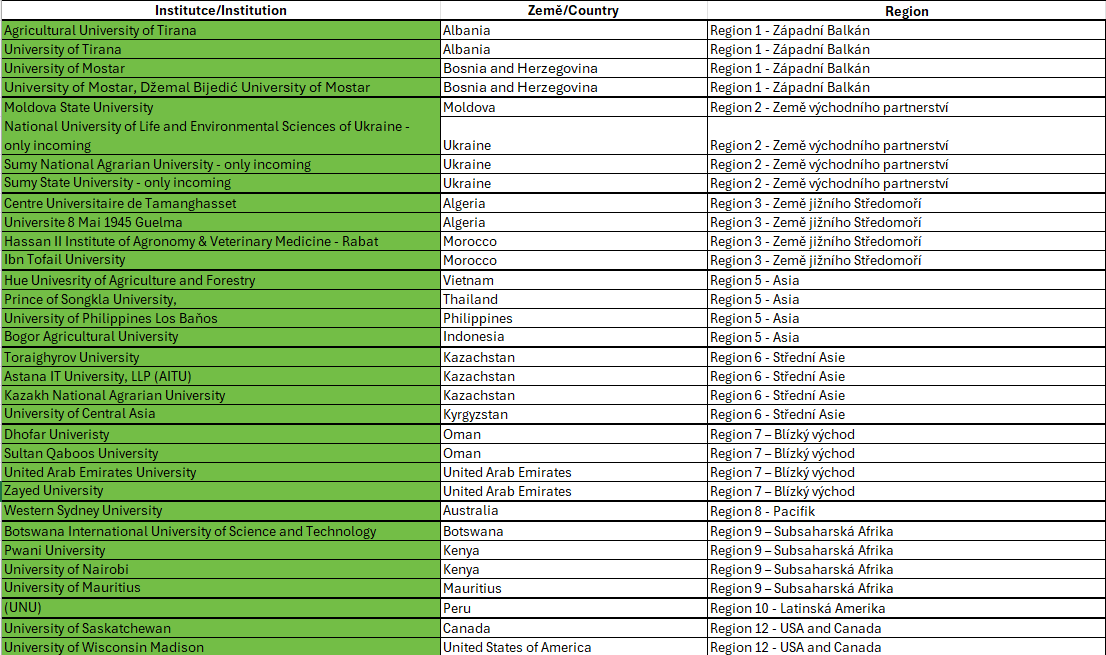
CZU Priority institutions for International Credit Mobility - Erasmus KA171 call 2026
Embedding CZU in international organisations and networks
One of the strengths of our University is its long-term and managed activity in international networks or organisations, which not only provides new opportunities for the University to exert its influence through its membership, but also contributes significantly to building the University's reputation as a leading European university.
Euroleague for Life Sciences (ELLS)
https://www.euroleague-study.org
The most important international network for CZU is the Euroleague for Life Sciences (ELLS), which CZU joined in 2005. ELLS is a network of leading universities cooperating in the fields of natural resources management, agricultural and forestry sciences, life sciences, veterinary sciences, food sciences and environmental sciences. The member universities are listed below. Within the ELLS, CZU offers mainly joint study programmes (joint and double degree) (FAPPZ CZU - BOKU Vienna /2x joint degree/; PEF+FZP CZU - WUR /double degree/; FTZ CZU - UHOH /double degree/). In addition, CZU is very actively involved in the activities of discipline-specific work groups. Ten representatives of CZU are active in nine of the eleven groups (two of which are led by CZU), five persons are active in the support groups and two in the governing bodies (CZU Rector in the ELLS Board and CZU Vice-Rector in the ELLS Task Force).
The principal activities of the network include the ELLS General Assembly and Forum, the Scientific Student Conference (in 2022, the events were held at CZU), joint degree programmes or the organisation of summer schools, workshops and competitions. In the period 2020-2022, CZU led the ELLS secretariat and thus coordinated the activities of the whole network. The ELLS has its own fund for incentives.
ELLS member universities:
- Wageningen University and Research (WUR, The Netherlands)
- University of Natural Resources and Life Sciences (BOKU, Austria)
- Swedish University of Agricultural Sciences (SLU, Sweden)
- Warsaw University of Life Sciences (SGGW, Poland)
- University of Hohenheim (UHOH, Germany)
- Norwegian University of Life Sciences (NMBU, Norway)
- Estonian University of Life Sciences (EMU, Estonia)
- L'Institut Agro (IAGRO, France)
- Hebrew University of Jerusalem (HUJI, Israel)
- Lincoln University (LU, New Zealand)
- Česká zemědělská univerzita v Praze (CZU, The Czech Republic)
LIFE: Euroleague for Life Sciences
In January 2023, CZU, together with the above-mentioned institutions, developed a project called the European University Initiative (LIFE: Euroleague for Life Sciences).
From CZU´s point of view, this is a very important undertaking and if the project is supported by the European Commission, it will influence the internationalisation and international anchoring of our institution for years to come. In addition to even closer cooperation with ELLS members in all areas, it will also bring about the linking of university systems, even more student-oriented activities or intensive scientific and research exchange. The EU supports "European universities" financially and sees them as flagships for the competitiveness of European higher education in a globalised world.
Association for European Life Science Universities (ICA)
https://www.ica-europe.info
It is a network of more than 60 universities from the EU and neighbouring countries (European Higher Education Area) focusing on biological sciences related to agriculture, food, forestry, natural resources, rural development and the environment. The Vice-Chancellor for International Relations is a member of the Board and the ICA Secretariat is located at CZU. Within the ICA there is a work group focused on an emerging field called bioeconomy, where the CZU is represented by the Vice-Rector. The ICA has adopted a new strategy in 2022 and, among other things, aims to be the voice of Life Science universities in Brussels.
The European Alliance on Agricultural Knowledge for Development (AGRINATURA)
https://agrinatura-eu.eu
Agrinatura is a network of 35 European universities and research centres with the aim of promoting sustainable development in agriculture and is also the ICA's standing committee. It is dedicated to research and education in the tropics and subtropics. CZU has been a member of the association since 2004 and was also the seat of the secretariat until the end of 2022. The current Vice-President of the Agrinatura Association is the Vice-Dean for International Relations of the Faculty of Tropical AgriSciences. The organisation promotes collaborative projects and the translation of the latest knowledge into practice, particularly in the tropical and subtropical regions of interest, with a special focus on Africa. It seeks to proactively influence policy for agricultural research in Europe and globally.
Among the principal events of the association is the annual General Assembly (GA), which includes meetings of members, partners mainly outside Europe and partner organisations, as well as scientific workshops and conferences. In 2023, CZU will be the host institution.
The list of member universities is available here.
The ICA Regional Network for Central and South Eastern Europe (CASEE)
https://www.ica-casee.eu
CASEE is another standing committee of the ICA, currently chaired by CZU, and the Vice-Rector for International Relations has been the President of CASEE since 2018. CASEE focuses on cooperation between universities in the Danube Basin region, and CASEE members include institutions that are not members of the ICA. Similar to other networks, CASEE supports joint degree programmes, scientific conferences, summer schools, research cooperation and other activities such as the cooperation of experimental and teaching farms. CASEE is an associate partner of the "European university" (network) EPICUR.
International Network for the MBA Agribusiness and Commerce (AGRIMBA)
https://www.ica-agrimba.eu
Within ICA, CZU is also active in the AGRIMBA network (organisations focusing on MBA programmes in agriculture), of which it was a founding member in 1995.
The ICA Standing Committee for Forestry (SILVA)
https://ica-silva.eu
SILVA is a non-profit association dedicated to higher education in forestry. Its primary objective is to stimulate and facilitate inter-university cooperation in forestry education in Europe.
Danube Rectors´ Conference (DRC)
https://www.drc-danube.org
The cooperation of the universities associated in this network focuses mainly on their activities in the implementation of the EU Strategy for the Danube Region (e.g. preparation of projects related to the Danube Operational Programme). At the annual meeting of the DRC in Bucharest, Prof. Balík, Rector Emeritus of CZU and also former President of this organisation, received an award from the Austrian Federal Ministry of Education, Science and Research.
European University Association (EUA)
https://eua.eu
CZU is also a member of the European University Association, which means it can directly influence the direction of European policy in the field of tertiary education.
International Business Studies Exchange Network (IBSEN)
https://www.ibsen-network.com
CZU, through the Faculty of Economics and Management, is a member of IBSEN, a network focused on enhancing and developing the intercultural competences of students and staff and supporting their professional development in a multicultural world.
Young Professionals FOR Young Professionals for Agricultural Development (YPARD)
https://ypard.net
YPARD operates as a network; it is not a formalised institution. At the heart of the YPARD movement are its members, who are encouraged to become active in their field, spread the word about YPARD among other young professionals, promote a stronger youth voice in their own organisations, and share their views and ideas with other young professionals in the network.
This global online and offline communication and discussion platform is designed to empower young agricultural leaders around the world to shape sustainable food systems.
YPARD is coordinated at European level by the Faculty of Tropical AgriSciences at CZU.
European Forest Institute (EFI)
https://efi.int
EFI is an international organisation established by European countries. To date, 30 countries have ratified the agreement establishing EFI, including the Czech Republic.
EFI conducts research and provides policy support on forest-related issues. It facilitates and stimulates forest-related networking and promotes the dissemination of impartial and policy-relevant information on forests and forestry. It also promotes forestry research and the use of science-based information as a basis for forestry policy.
EFI's policy advocacy work includes increased support for decision-makers and policy makers. EFI supports policy and governance reforms to protect the world's forests. It facilitates partnerships between producing and consuming countries to promote legal, -deforestation-free and sustainable production and trade of timber and agricultural commodities.
CZU is active in EFI through the Faculty of Forestry and Wood Sciences.
International Union of Forest Research Organisations (IUFRO)
https://www.iufro.org
IUFRO is a non-profit, non-governmental, international network of forest science institutions that promotes global collaboration in forest-related research and advances the understanding of the ecological, economic and social aspects of forests and trees. IUFRO is a global collaborative network for forest science. It brings together more than 15,000 scientists in about 650 member organisations in over 125 countries. Scientists work in IUFRO on a voluntary basis and the Czech Republic is represented on the IUFRO International Council by Prof. Šišák from the Faculty of Forestry and Wood Sciences.
InnowaWood
http://www.innovawood.com/Default.aspx
InnovaWood is an umbrella organisation that integrates four European networks in the forestry, wood and furniture industries into a more effective grouping to promote innovation in these sectors.
InnovaWood has more than 60 member organisations in 28 European countries, including research and technology organisations, universities and vocational education and training institutions, all related to the forestry sector. The Faculty of Forestry and Wood Sciences is an active representative of CZU.
European Network for Learning and Teaching in Agriculture and Rural Development (ENTER)
https://enter.educagri.fr
The Institute of Education and Counselling of CZU is a member of the ENTER network, which links institutions specialising in vocational education in agriculture, forestry, horticulture and related fields.
International Union for Agroforestry (IUAF)
https://iuaf.org/
The International Union for Agroforestry is based at the Czech University of Life Sciences. It was founded in 2019 and registered in Prague 2020. Its establishment was supported by the Ministry of Agriculture; the necessary facilities and support were offered by the Rector of CZU, Petr Sklenička. It is an international union with the aim of representing the interests of this transformational way of farming in the agricultural landscape.
Czech Society for Agroforestry (CSAL)
https://agrolesnictvi.cz/
It is a society whose aim is to raise awareness of alternative uses of agricultural land in the style of agroforestry systems to improve the condition of the soil and the environment without reducing production. The aim of the society is to inform the public about the possibilities and innovations of agroforestry and to inform farmers about this way of farming. We also manage to participate in various national and international projects dedicated to research, popularisation and practical implementation of agroforestry. CSAL is also the Czech branch of the European Agroforestry Federation (EURAF), which helps us to influence even European agroforestry events and to bring inspiration in agroforestry practices from other European countries. CSAL is based at CZU.
Priorities and objectives of the internationalisation strategy
CZU Vision 2030+ in the field of internationalisation
The current Strategic Plan of CZU 2021+ itself contains a commitment to approach the ideal of so-called lived internationalisation, where internationalisation organically permeates all areas of CZU's activities and where internationalisation is not thought of as something specific, but as something that has become a natural part of everyday life.
Czech University of Life Sciences Prague provides a bilingual environment for its students and staff and, in line with its overall aspiration, is becoming a place of European scholarship, exchange and reputation. Its environment welcomes diversity, and the community of Czech University of Life Sciences Prague naturally integrates not only the national and international dimensions, but also the bearers of these aspects in the form of students, academic staff, members of departments, faculties, middle and top management, into the life of the institution.
At CZU, students and staff who speak Czech or English have the same opportunities and services. The international scientific community of CZU has emancipated itself and ambitiously applies for grants funded by non-Czech or even non-European grant agencies and sources. Science is primarily international, and departments accept international experts with no experience or previous education at Czech universities into their ranks. CZU actively motivates graduates of its degree programmes to pursue careers at foreign institutions and has overcome academic inbreeding.
Students at CZU have the opportunity and need to improve their skills in foreign languages, and it is natural to offer courses taught in English or other world languages in Czech-taught degree programmes. The number of outgoing students and staff are multiple and internationalisation at home is widely applied across degree programmes. Curricular flexibility in most degree programmes and the implementation of the mobility window (in its various forms) have facilitated the recognition of study abroad results. The multicultural environment of CZU and the high proportion of international researchers and PhD students has also brought English into the meetings and internal communication of faculties, departments and other university departments. However, the Czech language is not neglected and international staff are required to learn basic and more advanced communication in Czech with regard to life in the Czech Republic, for which the university provides excellent facilities and opportunities. In official communication, both languages are equal, and all internal regulations and communication are in both languages, even with the use of the latest technology and elements of artificial intelligence. Among other things, this enables CZU to involve international members of its academic community in academic self-government at all levels.
Student societies and organisations have integrated international students and are open to all students without language barriers. CZU actively promotes language exchange and support activities on campus. Services and counselling for students and staff are provided at the same level and to the same extent for all.
CZU plays a leading role in many international organisations and networks and its representatives hold executive positions. CZU professionally manages the facilities of these organisations and provides support to their secretariats. Together with or through its European partners, the CZU has active representatives, actively promotes its interests or comments on current events and policies in Brussels or in the agencies and programmes of the UN, the World Bank and other similar organisations.
The faculties do not compete with each other and perceive CZU as one institution of which they are a part and in this context they are building a unified brand that is unique and easily recognisable to foreign partners, applicants for academic and non-academic positions, as well as applicants for study from all over the world. CZU faculties follow a consistent approach in terms of admission requirements, deadlines and promotion. Through joint efforts, they have raised the prestige of studying at and belonging to CZU to a level that allows them to charge for studying in English at a level that international students contribute significantly to the overall funding of CZU and to the costs associated with living internationalisation, whether it be translations, salary conditions attractive to local and international academics, as well as language-equipped administrative apparatus, or decent scholarships for students in doctoral programmes.
CZU maintains contact with its alumni, has a global overview of alumni in important roles and positions and routinely activates them. CZU has a foundation that manages funds raised from alumni and supporters. The university is active locally and regionally and contributes to the development of nearby city districts, municipalities or cities where university businesses, research centres and other units are also located.
CZU is improving its position in international rankings and consolidating its leading position in campus sustainability.
The high number of double and joint degree programmes contributes to the international reputation and attractiveness of studying at CZU, and some of the Master's and Bachelor's
degree programmes have changed the form of the state final examination in the long term in connection with reaccreditation to better reflect the context of the times, including technological development. Discussions on a grading scale that would facilitate the transfer of learning outcomes have developed, not only in the context of cooperation with the European university partners LIFE: Euroleague for Life Sciences.
Analysis of factors supporting and restricting internationalisation of CZU
1. Supporting factors
• Large, beautiful, modern and green campus (all buildings part of a green park in the style of traditional US campuses)
• Great location of the campus (close to the airport and the historical centre of Prague, easily accessible by public transport)
• Attractive place to live and study (safe city and country, European metropolis full of culture and history with a modern and sustainable approach, popular with expats)
• Quality infrastructure for teaching, science and research (lecture halls and laboratories equipped with cutting-edge technology)
• A wide range of study programmes taught in English in various degree programmes
• A wide range of short-term study stays abroad (summer schools) and other long-term study and work stays abroad (Erasmus+ and non-EU exchanges)
• Offer of Joint, Double and Multiple Degree programmes with renowned universities
• Affordable study (availability of programmes with lower tuition fees for study in a foreign language) and housing (lower cost of living)
• Internationalisation as a strategic priority of CZU (supported by top management and institutionalized in strategic documents)
• A wide range of international partnerships and active involvement of CZU in international university networks (experience in chairing networks and running several secretariats)
• Popular destination for international students from all over the world (over 4000 international students study at CZU).
• Degree programmes attractive to students from non-EU countries.
• Increasing financial support for international academics, researchers or postdocs.
• Expanding the use of online learning.
• New opportunities for digitalisation
• Expanding international research
• Achieving international accreditation and certification
• Participation in the European University Initiative
• Supporting the participation of CZU members in international networks, follow-up networking and further use of this membership
• Improving the university's international evaluation (international rankings)
• Expanding PR and promotion with an international dimension
• Possibility to organise international conferences
• Focus on countries where the Czech Republic is popular
• Active recruitment from European Union countries (staff and students)
• Introduction and development of an ambassador programme (international ambassadors of CZU)
• Better work with students after their return from abroad (e.g. Welcome Back event)
2. Restricting factors
• Language skills of CZU staff (academic, non-academic and managerial)
• Unfinished process of setting up bilingual internal processes, communication and documentation at CZU, especially regarding international workers (intranet, payroll, benefits, websites...)
• Low percentage of internationals in management and decision-making bodies of CZU
• Low integration of international workers and students
• Low awareness of intercultural differences (e.g. between outgoing/ incoming students and staff)
• Low willingness and motivation for intercultural contact and communication (linked to low intercultural competences and language skills)
• Lack of access to psychological counselling in English
• Low involvement of students and staff in university life (not only related to internationalisation)
• Insufficient reintegration work with students and staff after returning from abroad (lack of feedback and subsequent adaptation, lack of access to career counselling, lack of access to psychological counselling)
• Insufficient use of student internships and job opportunities in the Czech Republic and abroad (general lack of connection with practices, lack of established commercial partnerships that could be offered to students)
• Ambiguous definition and division of competences and agendas of units involved in internationalisation (International Relations Office, Study Affairs Office, Science and Research Office, External Relations Division).
• Accommodation problems - low number of available beds
• Missed opportunities in cooperation with a wide network of partners
• There is still no unified internationalisation strategy for the whole university (internationalisation goals for the university and for individual faculties are not based on mutual agreement and clear priorities)
• Insufficient record (overview) of individual memberships in international institutions and networks
• Insufficient work with international alumni
• Problems related to the development of digitalisation
• Various constraints (government, EU, ...)
• The visa policy of the Czech Republic and the EU, which is not changing and probably will not change soon
• Global economic or social crisis
• Reduced interest in travel (e.g. due to COVID, CO2 emissions)
• Increased administrative burden
• Loss of reputation in internationalisation
• Reluctance of partners
• Problems with accommodation
• Loss of motivation (low student engagement and inactivity of student societies)
Strategic objectives in the field of internationalisation
Strategic objective 0: Sustainability of funding for the internationalisation of CZU
Strategic objective 1: Bilingualism of the university environment
Strategic objective 2: Developing relationships with key international partners
Strategic objective 3: Leveraging the added value of membership in international networks and organisations
Strategic objective 4: Unified international marketing of the university and a single brand and its promotion, effective recruitment of international students and staff
Strategic Objective 5: Development of student and staff mobility
Strategic objective 6: Creating a more welcoming environment for international students and staff