
According to the World Meteorological Organisation (WMO), 2025 was one of the driest years in terms of river flow over the past 35 years. At the same time, the long-term decline in water reserves across the landscape continued, and for the fourth year running, glaciers in all major glaciated regions of the world recorded a net loss of mass. Hydrologist Oldřich Rakovec from the Czech University of Life Sciences in Prague (ČZU) also contributed to the preparation of the new report, State of Global Water Resources.
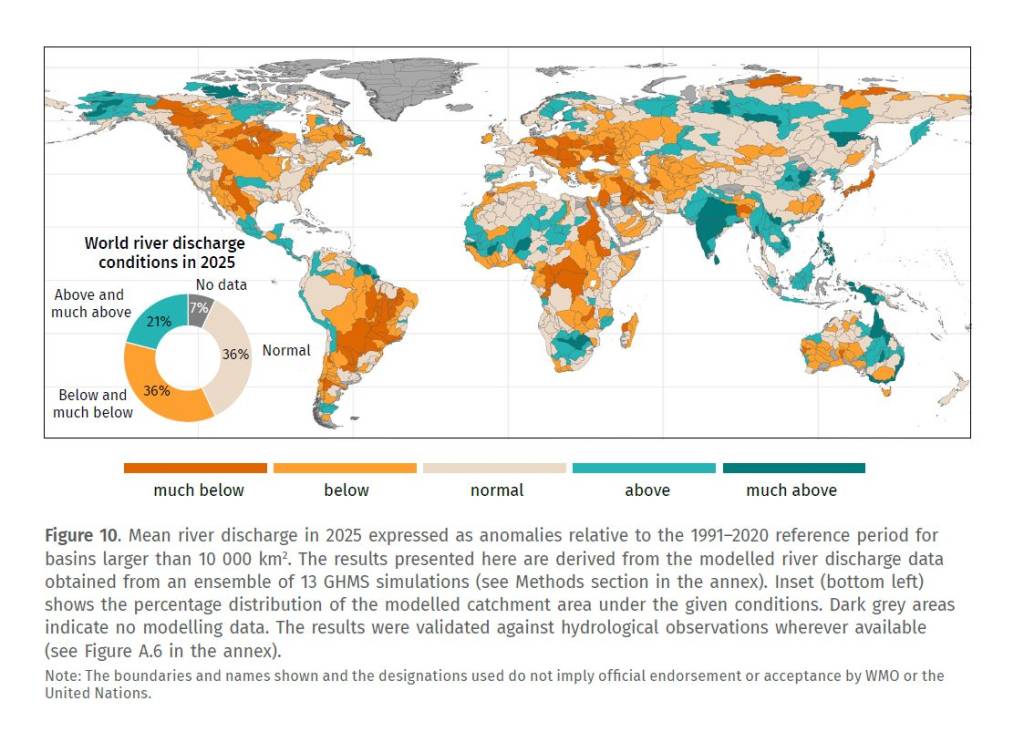
The report states that in 2025, river flows were below normal across 36 per cent of the world’s catchment area. The proportion of catchment area experiencing normal conditions remained significantly below the long-term average for the seventh consecutive year. Between 1991 and 2020, 46 per cent of the world’s catchment area on average experienced normal conditions; in the last seven years, this figure has been only 34–38 per cent.
The analysis also confirms a continuing decline in water reserves in soil, rivers, lakes, groundwater, snow and ice. Total water reserves in the landscape have been on a downward trend since around 2014–2016. A long-term shortage of groundwater was recorded between 2022 and 2025 in parts of Europe, the Americas, the Middle East, India, southern Africa and Australia.
The shortage of groundwater is a warning for the Czech Republic
The report also directly concerns Central Europe. Across Central and Eastern Europe, the WMO recorded persistently and widespread below-normal to severely below-normal groundwater levels between 2022 and 2025. Last year, total water reserves in the landscape and river flows in Eastern Europe were also below normal; snow conditions were below normal across the whole of Europe, and Eastern Europe, along with the Mediterranean, was hit by severe drought.
“The persistent shortage of groundwater in Central and Eastern Europe serves as a warning for the Czech Republic. It is precisely these groundwater reserves that help maintain river flows during dry periods; however, their replenishment takes longer than the rewetting of the soil surface. That is why it is important to protect water resources and promote water infiltration into the soil,” says Oldřich Rakovec, who contributed to the report by providing hydrological simulations using the global hydrological model mHM.

Glaciers around the world have shrunk once again
Furthermore, according to the report, glaciers in Central Europe may already have reached what is known as the ‘peak water’ point – the moment after which the amount of water resulting from their melting begins to decline permanently.
Glaciers are a striking symbol of the ongoing changes to the water cycle. In the hydrological year 2025, they lost approximately 408 gigatons of ice globally, which corresponds to a rise in global sea level of approximately 1.1 millimetres. This marked the fourth consecutive year in which all major glaciated regions recorded a net loss of mass.
Water reserves for dry periods are dwindling
According to its authors, the WMO report thus points to an increasingly unpredictable water cycle, in which periods of water scarcity alternate with extreme rainfall and flooding.

“Some parts of this cycle – such as rainfall, river flow and soil moisture – change rapidly, as they respond to the weather over a matter of days or weeks. Others, such as groundwater, glaciers and seasonal snow cover, accumulate or are depleted over periods of decades or even longer. These reserves have traditionally acted as the planet’s savings account or a buffer that absorbs the effects of bad years, ensuring that a single period of drought does not immediately turn into a water crisis,” says WMO Secretary-General Celeste Saulo.
“We are draining this metaphorical savings account. Global water reserves in the landscape have been on a downward trend since 2014–2016. This is a persistent signal that has been ongoing for ten years,” warns the scientist.
The full report from the World Meteorological Organisation (WMO) can be found at https://wmo.int/resources/publication-series/state-of-global-water-resources/2025.