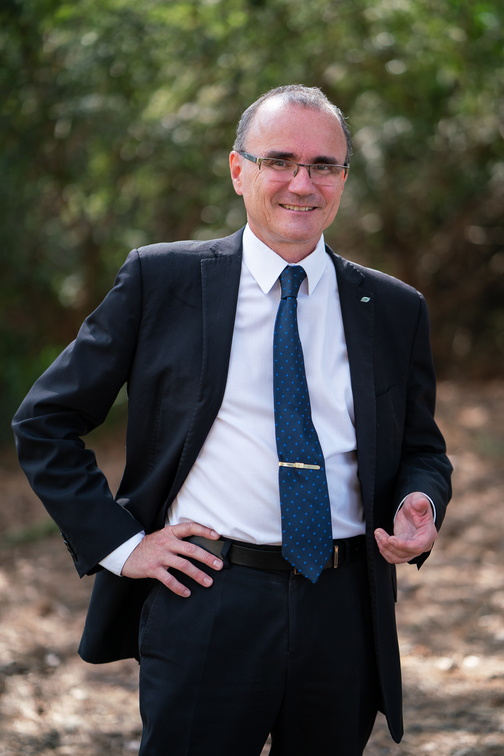
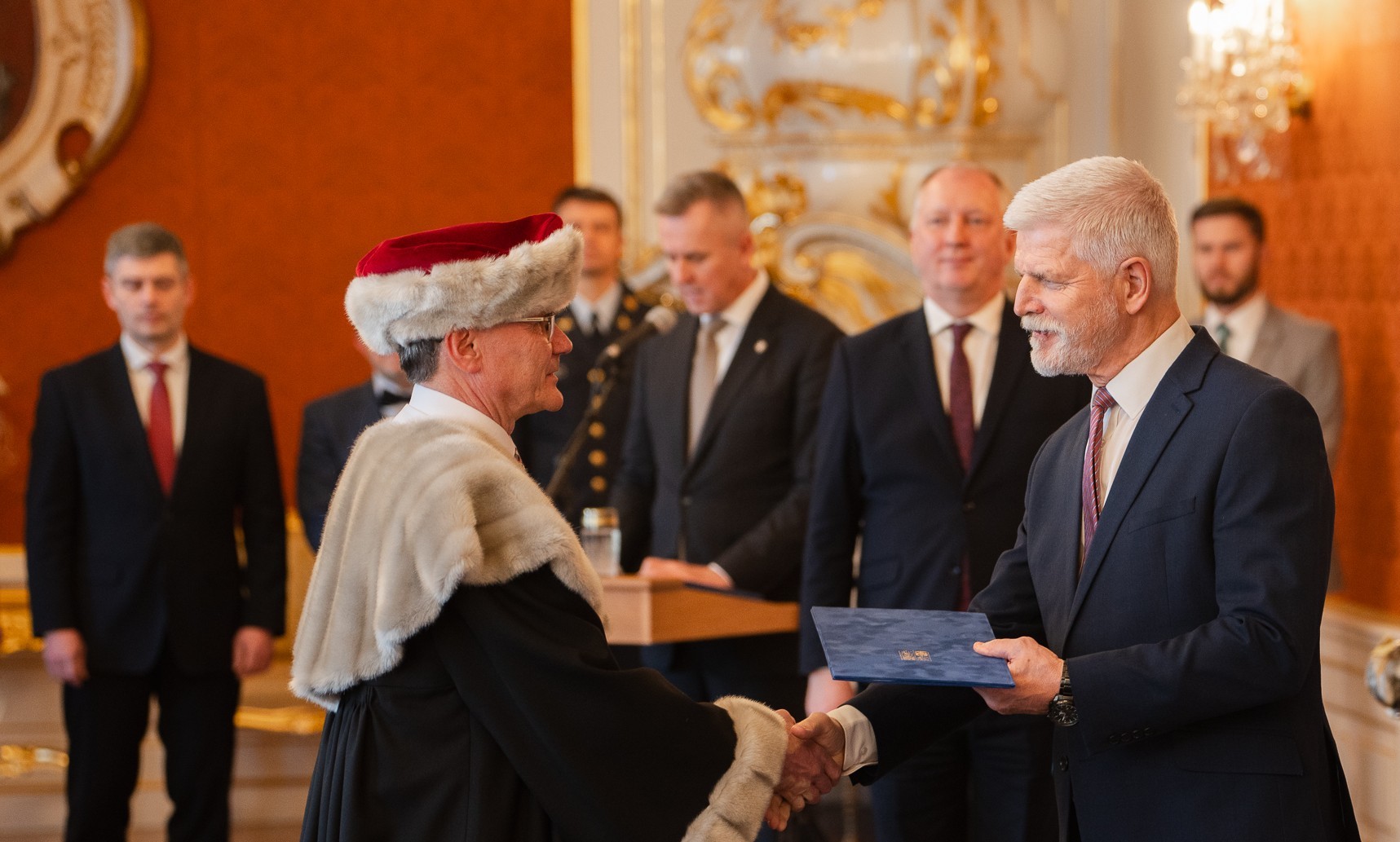
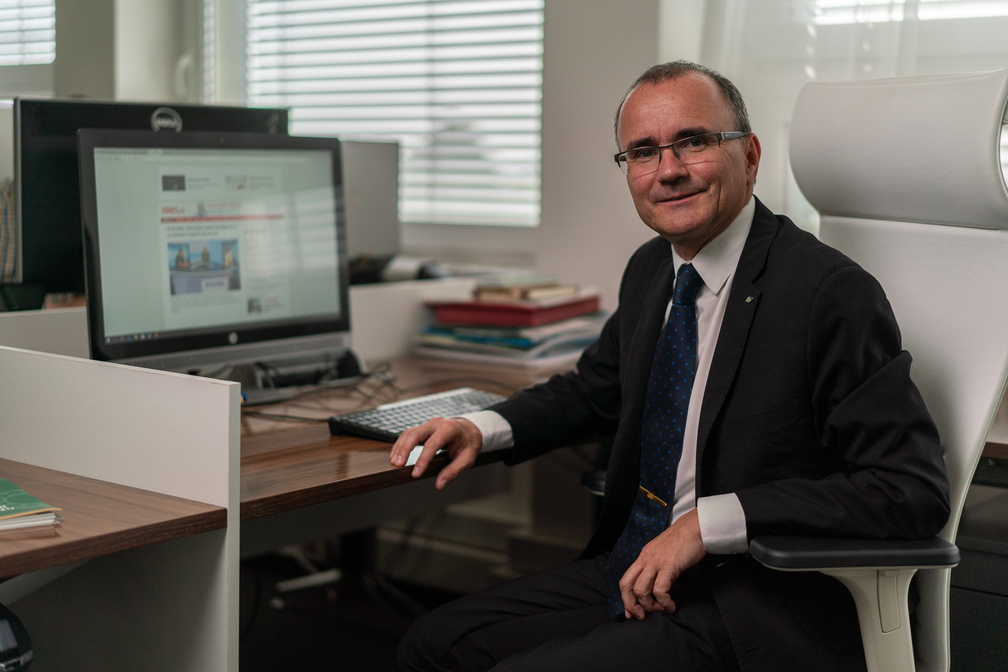
Over the next four years, the direction for the Czech University of Life Sciences Prague (CZU) will be set by the newly elected rector, Michal Lošťák. The Academic Senate elected him from three candidates in the autumn; the government then approved his nomination alongside those of other university rectors, and on 20 January 2026, the President of the Republic definitely confirmed his nomination. Starting on 1 February 2026, Michal Lošťák replaces Petr Sklenička as rector, who served for two terms of office. Professor Lošťák bases his vision on building an excellent university and on strengthening interpersonal relationships, as our interview with the new CZU rector reveals.
Mr Rector, for many people, CZU is a heartfelt matter. This feeling is especially true of its graduates, but also of those who came here from elsewhere, started working, teaching, doing research, and fell under the spell of the local genius loci. How did your relationship with CZU develop?
In this connection, a line from Vojtěch Jasný’s film All My Compatriots comes to mind: “In every person’s life there is one most decisive moment.” For me, that moment was an offer from CZU – then still the University of Agriculture. At the time, I was, in a way, an oddity. I had no ties to the school; I hadn’t studied there; I done’t have an agricultural or natural-science education. But I was allowed to conduct research and to become acquainted with the changing environment of the countryside and agriculture. That was in the early 1990s, in a time of significant upheaval. At the university, I met wonderful people. Everything was completely new to me. And that, in fact, shaped my relationship with the university – that I was such an oddity… It was an entirely new world for me. I lived in the dorms, so I was constantly in the middle of student life. That became even more interesting when I started teaching. Once I went into a little pub – today there’s a stop there called V Sedlci, and they sell cars there – and some students sitting opposite sent me to get beer. The next morning, I saw those students in the front row at a seminar. Here at the university, I discovered a completely different world. As a sociologist, I had primarily dealt with theory, and suddenly here was this excellent practice. Our research had links to agriculture and the environment, to the countryside, and so on. Maybe it’s even good when a person is such an oddity.
It sounds as though you spent your best years here. If someone offered you a position today at a prestigious foreign university, how would you decide?
Today I wouldn’t go anywhere, precisely because this is a matter of my heart. But in the 1990s, various possibilities were emerging. I decided to stay at the university because of the people who were there at the time. As I said, they were terrific, and I respect them to this day.
At the moment you are taking over, the university is competitive; in many respects, it ranks among the best in the country and has an excellent reputation worldwide. What do you consider its most significant strengths?
When I joined, we were the University of Agriculture; now we are a full-fledged university in every sense. I was there when we started in the 1990s – and where are we now? We have come an enormous distance. What we have become is probably our greatest strength; our reputation has risen tremendously. In the 1990s, people came here from an unnamed American university, saying they would educate us and explain how we should do things properly. That no longer applies – on the contrary, today others come here to learn and gain experience. Our greatest strength is our intellectual wealth: what we all have in our heads – not only technical skills, abilities, and knowledge, but also general know-how, how to do things. Sometimes it’s called intellectual capital, which also includes our greatest asset – the CZU brand and its awareness in the broader world. We are developing in a positive sense; we are growing as a “living university,” and we all benefit from it.
And what about the weaker points we should work on?
We should pay more attention to our sense of community and to our ability to cooperate. That does not exclude healthy competition – among faculties and departments and among individuals. But it is better to do things together, because individual interests and ideas can erode the whole. A university is not just me or you; it is something more. If we cooperate, if the university becomes the center of our lives and our heartfelt matter, it will benefit everyone. As a sociologist, I explain this using reference group theory. The university is the group we relate to, the model we want to be, and whose members we want to be. That is an enormous strength, and I would like us to continue in this direction.
You entered the rector selection process with a vision of building an excellent university through the cooperation of everyone who works and studies here. Which specific trends do you see as most effective in this regard?
For me, we must focus our efforts on creating a sense of safety and certainty in today’s turbulent waters. We constantly deal with the fact that what was still ordinary and self-evident for us not long ago is suddenly no longer working. Yet we need a feeling of certainty and security, and that is precisely what the university should provide. If we feel good here, we will function better. Everyone should feel that certain things are stable, and that at least some of what used to apply still applies today. If you go to work or classes every day with a knot in your stomach, not knowing what will happen in the next minute, you cannot perform well. So we need to set up an entire system of measures to achieve that inner certainty and become resilient.
When someone comes to CZU from elsewhere, it’s hard not to notice one thing: students here seem happier, more satisfied, more at ease than elsewhere.
That corresponds to what I tell my students about regional development. I want them to walk through the municipality where they live and see it through the eyes of someone who is there for the first time. At one town hall, they asked me what they should do, and I advised them: “Get off your backsides and go take a look around the town.” They did, and then they were surprised when people weren’t smiling at them. And I said: “No wonder. They probably aren’t smiling because you’re doing something wrong.” So I’m glad you say our students come across positively and are smiling. Hopefully, we aren’t doing it so badly.
What are your priorities with respect to the university’s students and employees?
A key priority for me is good interpersonal relationships. Another must be rewarding good work, not only financially, but also through non-monetary benefits, which can even include good food. Another, and in fact central, priority is excellence. We must maintain and enhance our research activities and be at the forefront in the fields that are truly ours. The results of our research must have an impact on society as a whole.
What is your opinion on the use of artificial intelligence at universities?
It is something we must take entirely seriously, and that will be crucial. Of course, I am in favor of using artificial intelligence, and whether we like it or not, any ban is out of place. AI can help us significantly in teaching, for example, in preparation. Recently, in the Rural Development course, I asked students to outline what they imagined the countryside might look like around 2040. The ideas varied; one student from Wageningen University would even like to see waterfalls in the Dutch countryside. Then I showed them what an artificial intelligence had conjured up, and they had to confront it. We are now at a moment similar to what our ancestors experienced with industrialization. It fundamentally changed the world. It went hand in hand with urbanization, with the abolition of serfdom, and with human emancipation. The world changed completely. Today we have artificial intelligence, which is a good servant, but we will probably have to think much more about the ethical dimensions: how far it should go so that we are not unpleasantly surprised in the end.
You already hinted that one of CZU’s great strengths is transferring research results into practice. How do you see this in the future?
We definitely want to keep promoting this trend, especially in areas where we are strong. We will have to support technology transfer into practice much more intensively, not only because it is also a significant source of income for faculties and rectorate units. At our university, we work on fascinating projects, and need to showcase them effectively. To show people what science can do and what they gain from it. That would also help build a barrier against today’s growing skepticism toward science and scientific authorities. In the past, if a scientist said something, it wasn’t debated; today, there are forums claiming the Earth is flat and the like. And everyone says: prove the opposite – after all, you’re the scientist…
You have long been involved in international relations. Will you have more chances to advance some of your goals from the position of rector?
My idea is that sometime around 2035, there will be something here we have called “lived internationalization” – something we won’t even need to talk about, because it will be everywhere. Internationalization is already part of teaching, science, research, and external communication. In this sense, our university is international already now. But it is also a significant challenge for the future. CZU is part of a university alliance currently known as the Euroleague for Life Sciences (ELLS), and when I speak with its representatives, they are burdened by the same problems as we are. Our shared priority is to make the agricultural and forestry sector attractive to the public, and to ensure that our core educational programmes are appealing to today’s society. Everyone takes it for granted that food exists, that nature exists, but it is not at all self-evident. A so-called “European University” project is now in the works, intended to include all universities in the ELLS alliance. It will be submitted to the European Commission on 4 March, and if it is approved, it will affect our university as well. Then, together with all partners – from Wageningen to the Estonian University of Life Sciences – we would create a joint European university.
We have outlined the question of cooperation among European universities. And what about Czech universities? When you say they should be an anchor in a turbulent society, is there similarly constructive cooperation among Czech universities, for example, on how to deal with social pressure and the devaluation of values?
I think our universities are very aware of this and are trying to address it. It is the biggest challenge facing the entire higher-education space. Each university is a fighter on its own, but together we move forward, and our cooperation works. For example, the Study in Prague initiative brings together all Prague universities to collaborate on their international presence.
What role, in your view, should universities play amid transformative social changes?
As I have indicated, the university should be an anchor, a lighthouse that points to the fundamental principles that make it possible to navigate these changes. Look – this no longer applies, but this still does. It should be a guarantor of authority, because the rule of science is being undermined. There is an erosion of authorities and a crisis of values. That is precisely how I see it, unfortunately. In the past, a teacher was an authority, a personality; suddenly, anyone can be anyone and an expert on anything; awards are given for anything, and even obtained through fraud.
Unfortunately, but let’s try to imagine where you would like to see the university after four years of your mandate.
I genuinely want us to be a top university in the area in which we operate, because we have enormous potential. It lies in our ability to connect natural sciences with social sciences. I therefore see our future in realizing this potential. It is our reputation – substantial intellectual capital, intangible, and symbolic. It is our knowledge, skills, and relationships between people. But of course, it is also economic potential and environmental capital – the setting of our campus. So my vision is of a rich university: rich not only in the traditional sense, but also thanks to its people, its beauty, and the ideas it produces.
What would you like to say to students?
Today, people talk about so-called snowflakes. But I don’t think it’s the best metaphor. They don’t melt like snow; they are uncertain. Their uncertainty stems from the enormous range of choices young people have. Suddenly I can do this, that – and now I don’t know what to do with it. Then a tiny problem appears, and a student doesn’t know how to deal with it, because they don’t have instructions for everything.
Can this be addressed somehow?
Perhaps I would see a solution in what lies at the core of our strategies – sustainability. What is sustainable is long-term. And if it is long-term, it can’t be different tomorrow and different again the day after. In short, sustainability is rooted in the very foundations of our university – in the stewardship of what one does. A farmer knows that next year they must plant again; the long-term perspective is evident there. Nature does not allow us to avoid thinking ahead and demands continuity. I would see it this way: we have the potential to be a university that can return the world to a normal course of events, and thus become resilient. I’ll borrow the words of Anthony Giddens, the author of Runaway World: How Globalisation is Reshaping Our Lives. It is about how to bring our world, which is slipping through our fingers, back under our control. And I think that is what it’s about today.
A new critical stage of life now awaits you. Are you entering it with joy, or with apprehension?
I accept this new role with joy and see it as a challenge. But I also know that I’m not some inexperienced hotshot anymore. I am aware that problems may arise. If I didn’t allow for that, I might later regret it. One has to keep perspective, but on the other hand, we must solve things, not sweep them under the table and pretend nothing is happening. And in the end, the solutions to problems can be surprising – positively for some, negatively for others.
Interview conducted by: Lenka Prokopová
Photo: Tomáš Fongus (KPR) / Petr Zmek